The tree fern Tempskya
Petioles sprang constantly from the stems. At the outside of the trunk they developed into 'phyllopodia' or leaf bases. It is assumed that the leaves of the plant were attached to them, but it is not known what they looked like. Attached leaves have never been found. The 'false stem' could reach a height of about 6 ms and a diameter of 50 cm. A stem has been found measuring 1 m. The biggest diameter observed is about 40 cms. The drawing above is the restoration by Andrews en Kern (1947). Click here for the way in which Andrews and Kern thought the tree developed.
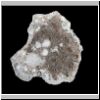
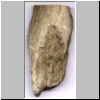
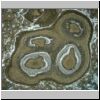
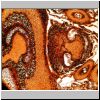
The petrified specimens of Tempskya from Europa are mostly
incompletely preserved. In some parts of the U.S. like Idaho and Wyoming
perfectly silicified trunks occur. We received a disc of such a trunk from
Prof. T.N. Taylor of the University of Kansas. Click the photos below to get more information and more photos.
|
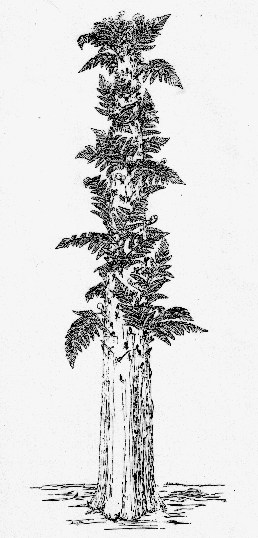 Tempskya is a genus of tree ferns.
Untill now the fossils have been found exclusively in Cretaceous sediments.
The trunk is called 'false stem' because it is composed of many small ramifying
stems and large numbers of adventitious (aerial) roots.
Tempskya is a genus of tree ferns.
Untill now the fossils have been found exclusively in Cretaceous sediments.
The trunk is called 'false stem' because it is composed of many small ramifying
stems and large numbers of adventitious (aerial) roots.