Identification table for some
species of Sigillaria |
The clubmoss tree Sigillaria
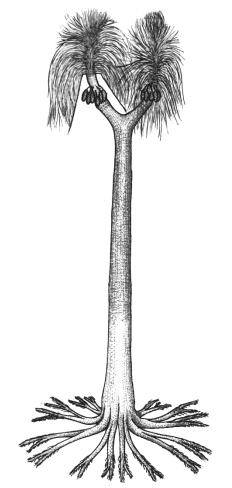
The clubmoss trees of the genus Sigillaria formed an important
part of the coal swamps in the Late Carboniferous. They could reach a height
up to 30 ms and bore grasslike leaves in the upper part of the unbranched
or once divided trunk. The leaves were attached directly to the stem and
they left scars when they were shed.
Characteristic of the genus of Sigillaria is the fact that the
leaf scars were arranged in vertical rows. On the ground of these leaf scars
many species have been described.
The trunk was somewhat thickened at the base.
The spore-cones were attached in or under the crown directly to the stem.
They are called Sigillariostrobus.
The underground parts of the tree can hardly be distinguished from those
of Lepidodendron and they are called Stigmaria.
From the Westfalian D on the number of species of Sigillaria
diminished strongly.
Click the parts of the tree to see photos of fossils.
Possibilities:
underground parts, trunk, base of the trunk (syringodendron), leaves,
spore-cones. |


